Saturday, June 22, 2013

Showing off


How does it look?
Although I've participated in quite a few group art shows, last week was the first time I was the featured painter. Sixteen of my most recent pastels will be on exhibit at Tate Condominiums in Eugene through the end of August. I'm sharing the limelight with sculptor Debbe Cornitius whose stone and metal sculptures are remarkably compatible with my work. Because the show is in a private residence it was open to the public only during the reception last week. The exhibit looks great, the reception was well-attended, and lots of friends from our 35 years in Eugene showed up to lend support and share my happiness. Four paintings sold at the reception and another one sold a few days later! I want to give special recognition to my husband, Alan, who does all my matting and framing. As one of the guests who has worked in galleries said, "The presentation is a big part of the impact and Alan's work very nicely done."
Tricia, Dorothy, Larry
Debbe's sculptures + my paintings = gorgeous exhibit

Tricia, Sarah, Dorothy, Geraldine
Debbe, Sherrill, Sally
Geraldine, Sarah, Ed
Debbe and I discuss our art with the guests
Justin, Julie and Ed

Sunday, June 2, 2013

Quiz

Springtime in Portugal/pastel/18x12
I've been busy getting work ready for a show this summer. Here are three new paintings that will be in the show. They have at least five qualities or features in common. Can you guess what I'm thinking about?

Sun and Shadow on a Gravel Road/pastel/18x12
Copse and Field (Mosier, Oregon)/pastel/12x18

Monday, May 27, 2013

Random thoughts about paint and pigment

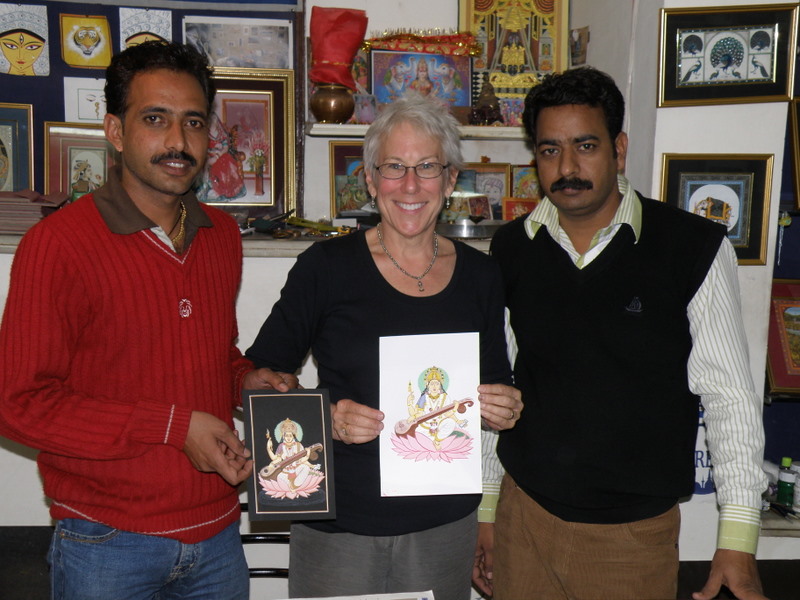
Me and my teachers in Jaipur, India in 2009.
Here I'm shown with my teachers of miniature painting in Jaipur, India, in 2009, holding my interpretation of the goddess Saraswati. There were only three students in the class and the others left after an hour or so but I stayed all day and my teachers said I was the best non-Indian student they'd ever had. (I'm not sure if they admired my ability or my persistence!) We made our paints by mixing powdered pigment (similar to that in the photos below) with water. One of the brushes was made from a camel's eyelash, another from squirrel hairs.

Paint pigments for sale at a market in India.
Paint pigment in Venice, Italy, March 2009.
When I paint in public with pastels folks often ask, "Is that chalk?" Nope. Pastels are paints in solid form. Paint is made of pigment (particles of color) held together with a binder, and the nature of the binder determines the kind of paint and how it can be applied. Oil paint pigments are held together with linseed oil and runny or mushy when squeezed from the tube so are usually applied with a brush or knife. Pastels are made by mixing pigment, water and a binder such as gum arabic or gum tragacanth into a paste which is then compressed and dried into sticks of color. Pastels have a higher concentration of pigment than any other artist medium which explains why their colors are so brilliant. Another unique quality of painting with pastels is that they're applied to a surface by hand (much like drawing) with no brush to get in the way. Pigments can be organic, inorganic, or synthetic and can come from animal, vegetable, mineral or synthetic sources. Ochres and iron oxides come from the earth and have been used since prehistoric times. Natural indigo blue comes from a plant. The color burnt sienna is produced by baking a certain soil from Italy in a furnace then grinding it into powdered pigment. Because blue and purple pigments were difficult and expensive to obtain, those colors were associated with royalty in ancient times. To learn more about pigments, Wikipedia has a thorough and fascinating explanation. 

Sindoor applied to a stone carving in India.
Paint is used throughout the world for a variety of practical, aesthetic and religious purposes. In India, red sindoor (vermilion) is often applied to the part in a woman's hair to indicate that she is married, or as a "tilaka" or "bindi" on the forehead. Sindoor can  be made from turmeric powder which becomes red when mixed with lime juice or lime powder and moistened in water. In the photo to the left, paint is regularly applied to an ancient religious image.

There's a lot to learn and love about paint!


Wednesday, May 22, 2013

Making lace in Barcelona

Spanish Dancer Wearing a Lace Mantilla by Mary Cassatt
One day in Barcelona on my way to somewhere else, I passed a little shop where women were gathered around a table making lace. It was the Escola de Puntaires de Barcelona, a school that teaches the centuries'-old art of lace-making with bobbins in a style specific to the region of Catalonia.   (Here's the link to their Facebook page.) To the left is a painting by Mary Cassatt featuring a Spanish mantilla or veil, a traditional item of clothing that is often thrown over the top of a tall comb called a peineta.

I found a link to an informative website on Spanish lace making that includes a remarkable "old timey" video in Spanish about lace. And here's another link to information about Spanish lace written by the lace-making expert Carolina de la Guardia. Additional internet searches for Catalonia lace show that clothing designer Calvin Klein has used it to decorate a line of women's underwear.

The women making lace at Escola de Puntaires welcomed me into their shop. I, with my limited Spanish, and they, with their
limited English, managed to communicate friendship and mutual joy in the creation of beautiful objects.


Monday, April 22, 2013

Painting on the Road: Ronda, Spain

Canopy of trees made wispy shadows
Ronda, Spain, is one of the pueblas blancas (white villages) with Moorish roots built along cliffs for strategic defense advantages. The scenery in Ronda is especially spectacular. One day while my husband hiked I stayed behind to paint. There were so many views to choose from! Most of the wide vistas felt overwhelming to me, so I chose the more intimate setting of the lovely Alameda del Tajo park established in the 19th c. A musician was playing her dulcimer as tourists and residents strolled, lingered on park benches, and chatted with friends. Chirping and fluttering birds along with the scent of wisteria, orange blossoms and jasmine were carried on a warm breeze. When working en plein air I generally work for about 3-4 hours and get two paintings started, taking a few photos of my scene as I go along. This allows me to catch the light on my subject and finish the painting in my studio if it continues to interest me. I don't necessarily want to replicate exactly what I see (I have the photograph to show me "reality"), but I do want to capture what interested me about what I saw or my feelings or memories about the day or the place. On this particular day I was thinking about light and shadow and pink blossoms. And I was feeling very, very happy.

Ronda, Spain
Ronda, Spain


Ronda, Spain

Ronda, Spain


Saturday, April 20, 2013

Painting on the Road: Jerez de la Frontera, Spain

Picasso's sherry at Bodega Tio Pepe, Jerez, Spain
Jerez (pron. hair-eth) de la Frontera is located in Andalucia in Southern Spain, a jewel of a city with an alcazar (Moorish palace/fortress), archaeological museum, bodegas (wine cellars, especially sherry--the word is an version of "Jerez"), equestrian farms, clock museum, outrageous flamenco and tapas bars... I could go on and on. But here are a few pictures to tell a story about sculpture, painting, urban design, ceramics, topiary, food presentation, music...all the sensual attributes of perception (texture/form/scent/line/compositions/color/taste/sound) that make an artist swoon.

Chandelier in our room, Jerez
La Cura del Flamenco, Jerez


Sherry dedicated to Jean Cocteau at Tio Pepe in Jerez
Every door had a knocker, most are unique.
Hungry? Eat!

Que quiere decir? No se.

Young people having fun at Damajuana, Jerez

The scent of orange blossoms,  everywhere


Real Escuela Andaluza del Arte Ecuestre


Grapevines will provide shade
Jerez Alcazar
Real Escuela Andaluza del Arte
Ancient relic at archaeological museum, Alcazar, Jerez
French clock, clock museum, Jerez
What lies beyond? Follow the light.
Museo Arqueológico Municipal de Jerez 
Alcazar is a feast for the senses

Friday, April 19, 2013

Painting on the Road: Seville, Spain

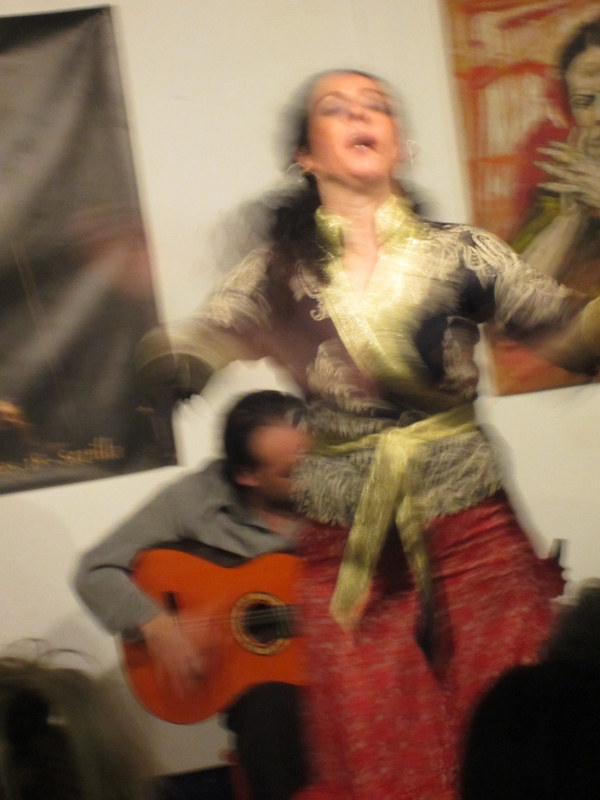
Ever tried to paint a hummingbird in flight? That's what it's like trying to paint a flamenco dancer in action. I took my pastels to our neighborhood flamenco bar and got a pretty good gesture drawing, but that was about it. So I sat back, drank another vino tinto, ate some more aceitunas, and enjoyed the scene.
Prepared to paint at neighborhood flamenco bar, Seville
Flamenco dancer, Carboneria, Seville


Painting on wall at Carboneria

Pedro Agudelo M., artist at Carboneria, Seville


Example of art for sale at Carboneria. Ole!